Devil in the White City: Murder, Magic, and the Fair that Changed America by Erik Larson is a fascinating book. It's one part true crime, one part architecture, two parts biography, and one part cultural history.
(I should note here that UMF doesn't own a physical copy - though we'd be glad to get one for you through request from MaineCat - but we do have access to an ebook version - click on the Ebrary Subscription link on that page.)
The events of Devil in the White City take place before and during the 1893 Chicago World's Fair, a massive undertaking by the city (and the country) to display the best of American ingenuity, creative thought, and all sorts of other things. Well-known architect, Danial Burnham was working on plans to display Chicago's space for the Fair to its full advantage.
At the same time, a serial murderer was setting up in the city. H. H. Holmes (as he was known) acquired property in Chicago, designing and building a hotel that was both business and deathtrap. Over the course of the Fair, he killed a large number of people, finally to be caught
What makes this book fascinating is the interweaving of the two stories: creation and imagination on one hand, death and misery on the other. Larson does an amazing job wrapping the two together, and putting them in the larger context of 1890s Chicago. Larson is also thoughtful about the more graphic details he includes, given the subject matter.
Showing posts with label Reviews. Show all posts
Friday, October 14, 2011
Friday, October 7, 2011
Book Review Friday: Stiff
I was enthusing about Stiff: The Curious Lives of Human Cadavers (by Mary Roach) to a co-worker last night, and realised it'd be a great book to talk about here.
First, a little background. Mary Roach's gift as an author is to investigate complicated topics with a combination of humor, thoughtfulness, and curiosity that makes for a wonderfully readable and informative book. Makes sense, when you realise that she's tackled what happens to donated cadaver bodies after death, sexual physiology, the practical complications of spaceflight, and the question of ghosts, the afterlife, and things like near-death experiences.
What I like most about her books, really, is that sense of curiosity - of being willing to ask questions and explore topics that are so often not talked about in our society. I learn something new from reading her books in every chapter. The other thing I like is how she goes and talks to people, rather than just theorising from her own experience, or synthesising reading. Those things are good, don't get me wrong - but it's even more interesting to see her interactions with passionate ghost hunters, mediums, and scientists.
Stiff is her first book. In it, she explores how plastic surgeons and reconstructive surgeons use cadavers to learn critical skills, a great deal about forensics, crash-testing cars, testing how to survive minefield explosions, and the question of what happens at the moment of death. While that sounds deeply gruesome to many people, she handles the topic with a decided amount of delicacy. Her writing leaves you aware of the people involved in a compassionate way, while also being clear about the science and pragmatic results of the research. It's an unlikely but very readable and informative combination.
Highly recommended - and I recommend her other titles, as well, though you'll need to request them from other libraries.
Friday, August 26, 2011
Review Friday: The Immortal Life of Henrietta Lacks
This book is one of my favorite recent looks at the world of science. (And it's available in our Discoveries collection, found in the Browsing Room opposite the Access Services desk of the library.)
The first question on your mind is probably "Who is Henrietta Lacks?" The initial answer - that she was a poor African-American woman who was treated for cancer at Johns Hopkins in the early 1950s - is probably not too exciting.
But what if I told you that she, in a very pragmatic way, helped with the following?
- testing the 1952 polio vaccine, which protected millions of children.
- proving that we have 23 chromosomes, helping with the diagnosis of a wide range of genetic conditions.
- providing the initial spark for scientists to figure out how to keep a single cell alive and grow a line of cells from it (used for everything from in-vitro fertilization to cloning).
- offering ideas for creation of anti-cancer drugs now in clinical tests.
Here's the thing, though: she didn't give informed consent. (She wasn't even asked, which was common at the time for everyone.) She died in poverty. Her extended family, many of whom are still alive, continued to live in poverty, unable to afford the technological advances that her tissue helped doctors create. They spent many years not knowing what that cell culture meant, or what she'd contributed. And for decades, her very name disappeared from the record.
Henrietta's story is about a lot of other things. What right do we have to our own tissue, even after it's removed from our bodies? What does it mean to be an informed health consumer? What does access to health care really mean? What is the intersection between personal choice, research, and commercial profit? And what should happen if - like Henrietta Lacks - our cells turn out to have some unusual quality?
Rebecca Skloot takes this complicated story and makes it readable, interesting, and compassionate as she begins by figuring out why the HeLa culture was called that and winds up diving deeply into the life of the Lacks family (to help them find answers). It's a fascinating read, with clear language that's friendly to the non-scientist, and it's sure to get you interested in other questions of bioethics, health care access, and science.
If you'd like to learn more, Rebecca's website has lots more information, including an extensive FAQ (and a movie is in the planning stages.)
Friday, July 1, 2011
Review Friday: Treasure of the Sierra Madre
That line is a gold mine. It's almost as versatile as Supercalifragilisticexpialidocious, with the added benefit that if you say it loud enough, you sound awesome, instead of just precocious.
I had the pleasure last night of introducing a friend to Treasure of the Sierra Madre (actually to Humphrey Bogart movies in general, as well). And it occurred to me while watching it that a lot of my readers out there might not have seen the movie (voted as AFI's #38 best film of all time). If you haven't seen this film, then you owe it to yourself to rent it (or check it out from a certain library--hint hint.)
It focuses on Bogart, a down-on-his-luck drifter who's desperate for money. He dreams up a plan to go pan for gold and strike it rich, even though he has no experience with the wilderness at all. He meets an acquaintance who decides to go in with him on the expedition, and they convince and old-timer to be their guide. Naturally, gold is found. But the movie isn't really about striking it rich--it's about the effect of money on people. The lack of it, the abundance of it--money money money. The old-timer (director John Huston's father) has a quote that sums it up: "I know what gold does to men's souls."
If you're not a regular classic movie watcher, then you need to realize going into this that the movie is paced differently from the adventure movies of today. There are fight scenes, there's tension, but it's a different rhythm, and you need to give it time to develop. Bogart has a superb performance--one of the best of his career, and really an iconic one at that. I don't recall a more believable and disturbing descent into insanity and paranoia captured on film. Really great stuff.
In any case, give it a shot. The last time I'd seen it, I was in my young teens. This is a movie that gets better with age. Four stars.
Friday, June 17, 2011
Movie Collection Highlights: Westerns
- The Man Who Shot Liberty Valance--John Ford directed it, and it stars Jimmy Stewart and John Wayne. "A senator, who became famous for killing a notorious outlaw, returns for the funeral of an old friend and tells the truth about his deed."
- The Good, the Bad, and the Ugly--The Clint Eastwood classic. It brings shifty eyes to a whole new level of zen. "A bounty hunting scam joins two men in an uneasy alliance against a third in a race to find a fortune in gold buried in a remote cemetery."
- Butch Cassidy and the Sundance Kid--Paul Newman and Robert Redford should have been in 20 movies together. At least. But at least they were together for this one. "Two Western bank/train robbers flee to Bolivia when the law gets too close."
- Rio Bravo--Howard Hawks was another big figure in early westerns. This is a great example of why. John Wayne, Ricky Nelson and Dean Martin help, too. "A small-town sheriff in the American West enlists the help of a cripple, a drunk, and a young gunfighter in his efforts to hold in jail the brother of the local bad guy."
- The Searchers--Another Wayne/Ford classic. "As a Civil War veteran spends years searching for a young niece captured by Indians, his motivation becomes increasingly questionable."
- Stagecoach--The movie that put John Wayne on the map. "A group of people traveling on a stagecoach find their journey complicated by the threat of Geronimo and learn something about each other in the process"
- Shane--You'll be saying "Shane!" over and over for at least the next three days. Probably more. "A weary gunfighter attempts to settle down with a homestead family, but a smoldering settler/rancher conflict forces him to act."
- Unforgiven--Eastwood returns to the western genre, older and possibly wiser. "Retired Old West gunslinger William Munny reluctantly takes on one last job, with the help of his old partner and a young man."
- The Wild Bunch--Well known for bringing gore and brutal violence to the genre. "An aging group of outlaws look for one last big score as the "traditional" American West is disappearing around them."
- High Noon--Some fine suspense, and Gary Cooper. "A marshall, personally compelled to face a returning deadly enemy, finds that his own town refuses to help him."
Friday, June 10, 2011
Movie Collection Highlights: Kurosawa Films
- Seven Samurai--"A poor village under attack by bandits recruits seven unemployed samurai to help them defend themselves." It doesn't get more classic than this film. It's gone on to influence all sorts of movies, and it's one of the best movies out there, hands down.
- Rashomon--"A heinous crime and its aftermath are recalled from differing points of view." This one isn't as much of a straight up Samurai movie, but it's still considered one of the greats.
- Ran--"An elderly lord abdicates to his three sons, and the two corrupt ones turn against him." Samurai meets King Lear. Another Kurosawa classic.
- Yojimbo--"A crafty ronin comes to a town divided by two criminal gangs and decides to play them against each other to free the town." More of a light-hearted movie.
- Sanjuro--"A crafty samurai helps a young man and his fellow clansmen save his uncle, who has been framed and imprisoned by a corrupt superintendent." The follow up to Yojimbo.
Friday, May 20, 2011
Thor: Something's Rotten with Rottentomatoes
Well, it's not that bad. It's just not that good, either. The biggest problem with the movie is that the effects come first, and the characters come . . . fifteenth or so. Honestly. The characterization in this movie is so bad, it makes made-for-tv sitcom writing glow by comparison. Thor is a total jerk. We are never presented with a reason to like the man/god. He's a jerk when he's 7, and he's still a jerk when he's 27. He gets banished to earth, where he does some more jerky things.
Then, he has his Big Moment. His moment when he realizes what a jerk he is. And that supposedly changes him. Makes him a Better Man.
The thing is, this Big Moment isn't big enough. Not to justify the change the audience is supposed to have in opinion about the hero. So much of a successful climax is prep work. You have to lay the foundation for a Big Moment, starting from the beginning. Step One is to make your character somehow likable or believable or at least understandable to the audience. Iron Man did a great job with this. Tony Stark at the beginning of Iron Man I is a total jerk. But he's a really smart total jerk, confident and capable. We don't like him, but we at least realize why other people do.
Why do people like Thor? He's got buddies who supposedly would follow him to hell and back. Why? Because he has a magic hammer? People who base their friendships on magical artifacts aren't the sort of people I relate to.
When Tony Stark has his Big Moment, it's sufficiently big. He gets kidnapped--becomes a victim of his own technology. He sees first hand the effects it has on people, and that changes him. That makes sense.
Thor has to slum it with humans for about 24 hours. Oh noes!
I could go on. Thor and Natalie Portman supposedly have a Love for the Ages in this film--or at least that's what it seems like we're supposed to believe. What is this love based on? A late night conversation on top of a building.
Wow.
That's epic. I can totally understand how one chit chat can change their lives completely. That's why I'm so careful about who I chat with when I'm on top of buildings. You don't want to say the wrong thing and then Wham!, you're in a lifelong committed relationship. Blech.
Anyway. Is Thor awful? No. Stuff blows up. People punch things. And it's shiny while it happens. That gets it 2 stars. But is it good? Not really. It's okay.
And that's where this post has been leading me. According to Rottentomatoes, 78% of critics recommend this movie. After I saw it, I started digging some more. For a critic to "like" a movie, they have to give it 2.5 stars out of four--sometimes as low as 2 out of 4. A movie could get a 100% fresh rating if 100% of critics gave it 2.5 stars.
That's not a great movie, folks. That's a decidedly average film. One I probably don't want to waste money on.
I've decided that the whole premise of Rottentomatoes is flawed. You can't boil down a review to a "yes/no" recommendation. That's why we have four stars, not just two to choose from. So from now on, I'm not using Rottentomatoes. You hear that, Rotten? You're Rotten. I'd rather use a service like Metacritic, which gives an average of the actual reviews. According to it, Thor got a 58. That's much more accurate. I'll try Metacritic for a while and see what it does for me.
How about you--what do you use to decide which movie to see?
Friday, May 6, 2011
Ken Burns Documentaries
Have you ever seen a Ken Burns documentary. If not, let me just say that you're missing out. This is a man who's so good at making documentaries, Apple named an effect after him. (The Ken Burns effect is when action is given to still photographs by zooming in or out of a particular spot of the photo. You've seen it before--I almost guarantee it.) Anyway, Burns has been steadily cranking out miles of documentary films over the years, all of them wonderfully done and very informative. The Civil War, Baseball, Jazz, World War II, The National Parks, Mark Twain--hordes of movies. I've been working on adding some of these to Mantor's collections, and they're getting cataloged and put into circulation at last. Right now we have two great ones to choose from:
- The Civil War is 660 minutes of film studying that period of history of America. 11 hours of meticulously researched material for you to watch and enjoy.
- The National Parks trumps that, giving you 750 minutes of material focused on the creation of the national parks system and then looking at their 150 year history.
Friday, April 8, 2011
Book Review and Movie Review: Wise Man's Fear, and Good Food
The Wise Man's Fear by Patrick RothfussMy rating: 5 of 5 stars
The Name of the Wind was one of the biggest things to happen in fantasy in recent years, making a huge splash on the scene, and propelling Patrick Rothfuss from newcomer to fantasy star. But you have to sort of wonder anytime an author has a breakout book--will he be able to do it again? After all, often with first books, the author has had years (sometimes even decades) to work on that one book. There are such things as one hit wonders, and I always worry that the first book in a series will then go on to pull a Matrix, with each subsequent book just proving that the lightning captured in the first was just a fluke.
So. Wise Man's Fear--the second book in Rothfuss's series. Would it be Name of the Wind: Revolutions, or The Name of the Wind Strikes Back?
I'm ecstatic and relieved to be able to report that it's a fantastic read. Easily as good as the first--likely better. It's books like these that bring new fans to the genre. It's got all the hallmarks of a great epic fantasy: engrossing characters, fully-realized world, complicated politics and intrigue, awesome magic system. The works.
Really the only question to ask yourself is what you thought of Book One. If you loved it, read on. If you didn't . . . we can't be friends anymore. :-) If you haven't read it yet, then what are you waiting for? It really is that good.
It's available in our Discoveries collection this month.
And secondly, we'll be showing a film next week as part of our On Our Minds programming this year. We've been looking at a variety of movies focused on the food industry, and this time up we have Good Food, a documentary focused on how food growers in the Pacific Northwest are pioneering efforts to return the food industry to a smaller farms model. While it lacks a centralized story--it's more of a collection of anecdotes about individual efforts, all of which share the same general topic--it does an excellent job of illustrating the variety of approaches available today to growing food locally and organically. If you're interested in seeing what other options are out there (beyond Big Agriculture and humongous farms), then come on out on Tuesday to the Lincoln Auditorium at 7pm to check it out.
Friday, February 11, 2011
Movie Review: The Philadelphia Story
I thought I’d take the time to tell you why Philadelphia Story is a movie you owe it to yourself to watch. It stars Katherine Hepburn, Carey Grant and Jimmy Stewart, and it was directed by George Cukor, based on a play by Philip Bary.
The story takes place in--you guessed it--Philadelphia. Not the city, really. More of a rich country estate near by. Tracy Lord (Hepburn) and C.K. Dexter Haven (Grant) were married but divorced some years ago. Now Tracy’s about to marry again, this time to George Kittredge, an up and coming politician. Haven pops up at the Lord estate the day before the wedding, accompanied by two “friends” (Spy magazine reporters hoping to get a scoop on the wedding), Mike Connor (Stewart) and Liz Imbrie.
I think what I like most about the movie is the dialogue and the way the characters interact. Anyone looking for an excellent example of a character-driven plot need look no further. Hepburn and Grant are spot on as a feuding divorced couple, and their interactions are fantastic, and Stewart is tremendous (and hilarious as a drunk). Better still, the plot never forces its characters to do things they wouldn’t naturally do. Everything--including the finale--fits and makes sense, something Hollywood isn’t always able to do. The film was nominated for six Oscars in 1941 (including best actress, supporting actress, director and picture) and won two (including a best actor statue for Stewart).
Too often these days, people are willing to overlook a movie just because it’s old. I have friends who see the latest pop culture efforts, but they’re missing out on so many movies that have proven their lasting worth. Sure, this is in black and white. So what? The characters and plot and dialogue are better than most of the films that come out today. It’s funny and intriguing and appealing to men and women alike. Or it should be, at least. I challenge you to watch this and then not like it.
As an interesting note, the play this movie was based on (by the same name) was also made into a fairly well-known musical: High Society, with Bing Crosby, Frank Sinatra and Grace Kelly and music by Cole Porter. It's a decent movie, but not even Bing's crooning and make it rise above Hepburn, Grant and Stewart. Sorry, Bing.
Four stars (out of four)
The story takes place in--you guessed it--Philadelphia. Not the city, really. More of a rich country estate near by. Tracy Lord (Hepburn) and C.K. Dexter Haven (Grant) were married but divorced some years ago. Now Tracy’s about to marry again, this time to George Kittredge, an up and coming politician. Haven pops up at the Lord estate the day before the wedding, accompanied by two “friends” (Spy magazine reporters hoping to get a scoop on the wedding), Mike Connor (Stewart) and Liz Imbrie.
I think what I like most about the movie is the dialogue and the way the characters interact. Anyone looking for an excellent example of a character-driven plot need look no further. Hepburn and Grant are spot on as a feuding divorced couple, and their interactions are fantastic, and Stewart is tremendous (and hilarious as a drunk). Better still, the plot never forces its characters to do things they wouldn’t naturally do. Everything--including the finale--fits and makes sense, something Hollywood isn’t always able to do. The film was nominated for six Oscars in 1941 (including best actress, supporting actress, director and picture) and won two (including a best actor statue for Stewart).
Too often these days, people are willing to overlook a movie just because it’s old. I have friends who see the latest pop culture efforts, but they’re missing out on so many movies that have proven their lasting worth. Sure, this is in black and white. So what? The characters and plot and dialogue are better than most of the films that come out today. It’s funny and intriguing and appealing to men and women alike. Or it should be, at least. I challenge you to watch this and then not like it.
As an interesting note, the play this movie was based on (by the same name) was also made into a fairly well-known musical: High Society, with Bing Crosby, Frank Sinatra and Grace Kelly and music by Cole Porter. It's a decent movie, but not even Bing's crooning and make it rise above Hepburn, Grant and Stewart. Sorry, Bing.
Four stars (out of four)
Friday, October 1, 2010
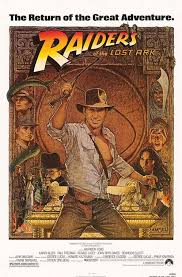
My Experiences with Raiders of the Lost Ark
So today's movie review isn't much of a review. I mean, I assume it goes without saying that virtually everyone in the world has seen Raiders of the Lost Ark. You have, haven't you? (If not, could you please tell me why not?) So what's the point in reviewing a movie most people have already seen, and the majority of the film world views as a classic?
Instead, I'm going to talk about the impact that movie has made on me. Because we all know reviews are all about the reviewer anyway, so why pretend they're about anything else?*
My earliest Raiders memories are quite vivid in my mind for a number of reasons. Number one, my family rented it from the movie store, and I dropped it down the stairs, breaking the video tape. The movie came out in 1981, so I figure I was probably in first grade or so by the time I dropped it down the stairs, although I suppose I might have been a bit older. I remember pretending to be Indiana Jones on the playground. In my mind, this consisted of rubbing my face a lot in contemplation, and then pretending to whip just about everything in sight. All I was missing was some facial stubble.
And of course, there's one other reason Raiders stood out in my elementary school mind: people's faces melted in it. Literally melted. Like, you could see their bones and everything. How cool was that? To think I lived in an age where I could see people's faces melt . . . beyond awesome. Looking back at that memory, I kind of wonder what the heck my parents were thinking, letting me see it. I mean, I think my son's still a year or two off from being able to watch it, but maybe I'm just more of a stickler than my parents were.
In any case, Indiana Jones was a pinnacle in my mind from a very early age. Since then, I've watched the movie many many times. I own the box set of the trilogy, and I enjoy seeing it each time. For more nitty-gritty details on the movie, check out the excellent imdb page on the movie. I love that site, and have spent many hours happily immersed in movie trivia and behind the scenes tidbits. (For example, did you know Raiders was Alfred Molina's first film? Or that the screenplay was done by the same guy who did the screenplay for another classic: Empire Strikes Back? Stuff like that just fascinates me. Gotta love the movie connections.)
My question to you all is this: what are your first Raiders memories? Please share, if you're willing. I'd love to hear them. And if (gasp!) you've never seen the movie, it's waiting here in Mantor for you to check out. Come on by and pick it up, then tell me what you think.
Happy Friday, all!
*To explain--Reviews vary wildly based on the reviewer. One person may love a film, another may hate it. I'm sure there are people out there who have never seen Raiders, or who wish they'd never seen it to begin with. That's okay. There are people who don't like bratwurst, either. The trick with reviews is to find a reviewer whose taste are close to your own, then listen to that reviewer and ignore everybody else. Who cares if 99% of reviewers hated a movie, so long as you loved it? Today, with Rottentomatoes and the like, people seem to want to defend their tastes. They're upset if other people disagree with them. That's silly. I can love a movie; you can hate it. I can't tell you that you're wrong, and vice versa. There's no right or wrong when it comes to taste.
Except with Raiders of the Lost Ark. :-)
Instead, I'm going to talk about the impact that movie has made on me. Because we all know reviews are all about the reviewer anyway, so why pretend they're about anything else?*
My earliest Raiders memories are quite vivid in my mind for a number of reasons. Number one, my family rented it from the movie store, and I dropped it down the stairs, breaking the video tape. The movie came out in 1981, so I figure I was probably in first grade or so by the time I dropped it down the stairs, although I suppose I might have been a bit older. I remember pretending to be Indiana Jones on the playground. In my mind, this consisted of rubbing my face a lot in contemplation, and then pretending to whip just about everything in sight. All I was missing was some facial stubble.
And of course, there's one other reason Raiders stood out in my elementary school mind: people's faces melted in it. Literally melted. Like, you could see their bones and everything. How cool was that? To think I lived in an age where I could see people's faces melt . . . beyond awesome. Looking back at that memory, I kind of wonder what the heck my parents were thinking, letting me see it. I mean, I think my son's still a year or two off from being able to watch it, but maybe I'm just more of a stickler than my parents were.
In any case, Indiana Jones was a pinnacle in my mind from a very early age. Since then, I've watched the movie many many times. I own the box set of the trilogy, and I enjoy seeing it each time. For more nitty-gritty details on the movie, check out the excellent imdb page on the movie. I love that site, and have spent many hours happily immersed in movie trivia and behind the scenes tidbits. (For example, did you know Raiders was Alfred Molina's first film? Or that the screenplay was done by the same guy who did the screenplay for another classic: Empire Strikes Back? Stuff like that just fascinates me. Gotta love the movie connections.)
My question to you all is this: what are your first Raiders memories? Please share, if you're willing. I'd love to hear them. And if (gasp!) you've never seen the movie, it's waiting here in Mantor for you to check out. Come on by and pick it up, then tell me what you think.
Happy Friday, all!
*To explain--Reviews vary wildly based on the reviewer. One person may love a film, another may hate it. I'm sure there are people out there who have never seen Raiders, or who wish they'd never seen it to begin with. That's okay. There are people who don't like bratwurst, either. The trick with reviews is to find a reviewer whose taste are close to your own, then listen to that reviewer and ignore everybody else. Who cares if 99% of reviewers hated a movie, so long as you loved it? Today, with Rottentomatoes and the like, people seem to want to defend their tastes. They're upset if other people disagree with them. That's silly. I can love a movie; you can hate it. I can't tell you that you're wrong, and vice versa. There's no right or wrong when it comes to taste.
Except with Raiders of the Lost Ark. :-)
Friday, September 3, 2010
Friday Night Movies
Friday is typically the day we review books and movies in our collection at Mantor. As I was surveying the recently added titles, trying to decide which one to review, I was having a really difficult time deciding which to go for. And then it hit me--why pick one? Why not give a brief rundown of some great films you could checkout and watch tonight? The past few years, we've really been trying hard to expand our film collection, cramming it full of quality cinema. I feel like we've done a pretty darn good job with that. (Of course, I selected most of the movies myself, so I'm admittedly a tad biased.) Practically any movie we have is a classic in one way or another. Most of them are older movies, many of which you might pass over because you weren't inundated with ads telling you to see them. Well, I'm here to tell you to go back and watch some of these gems.To make things more interesting, I'll present it as a challenge. The following are movies I have seen that are included in this month's new acquisitions list. How many have you seen? Can anyone tie me? Or better yet--can anyone go on the list and beat my number? Here we go:
Adam's Rib--classic Spencer Tracy and Audrey Hepburn film
Airplane--one of the prime screwball spoof comedies from the 70s
An American in Paris--famous Gene Kelly musical
The Birds--Classic Hitchcock
Born Yesterday--One of my favorite overlooked classics. Hilarious.
Braveheart--Remember when Mel Gibson wasn't a raving lunatic? No? Well, there was a time the man was known for film making, not insanity. Braveheart won him some major Oscars.
Chicago--Recent musical that helped put "musical" back in modern film making vocabularies.
Ghost--Never has making a pot seemed so sexy.
Raiders of the Lost Ark--Please tell me you've all seen this movie. Pretty please.
JFK--You can learn some pseudo-history, become a conspiracy theorist, and be entertained. All at the same time.
Kolya--Foreign films more your flavor? This Czech one's a goodie.
Million Dollar Baby--Who knew Clint Eastwood had such a great women's boxing movie inside him all those years he was Dirty Harry?
Moonstruck--Cher and Nicholas Cage, a realistic pair?
Papillon--Dustin Hoffman and Steve McQueen hellish prison goodness.
Pretty Woman--Julia Roberts is the only actress who could somehow create a reputation of wholesome goodness by breaking into the industry playing a hooker.
Rebecca--More Hitchcock goodness, just with less poultry.
Shakespeare in Love--The fictional true story of where Shakespeare got all his great ideas.
And there you have it--all the films I have seen of the ones we just added. I recommend any one of those. They're all great, in their own way. Sound like a lot to you? Maybe it does--until you consider we added 70 films. If any of you have seen all 70, I will buy you an imaginary pony. So don't anybody complain to me that they don't have anything to do tonight, or that nothing's on TV. Mantor's got you covered.
How many have you seen? Why not add one more to the list this weekend?
Friday, July 23, 2010
Documentary Review: From the Earth to the Moon
I thought I'd switch things up for a week and review something non-bookish. This is one of my all time favorite documentaries. If you're a space junkie like myself, this is a cornucopia of fun. 720 minutes of pure bliss. (12 episodes at an hour each, for those of you mathematically challenged, like myself.) If you're not a space junkie, you will be after you watch this. Produced by Tom Hanks and Ron Howard after they collaborated on Apollo 13, the movie tells the entire story of the American effort to get to the moon. It's a remarkable series, fully realized and dramatized. In other words, you learn a lot about history, but it's not just some guy summarizing events the whole time. Better yet, they made an effort not to dwell on pieces of history that had already been well-documented in other films. You get a real appreciation for the herculean efforts scientists and astronauts went through to finally be able to have a man walk on the moon. I love love love this series, and when I was adding documentaries to the collection, it was right at the top of my list. I can't recommend it enough. Four stars, and I just got back from looking at it on the shelf. It's waiting for you.
Come check it out!
Come check it out!
Friday, July 16, 2010
Book Reviews and a Little Bit More: The Yiddish Policeman's Union, World War Z, and New Spice
Three things for you this fine day. The first two are reviews, and the third is a YouTube clip from one of my old places of employment: BYU's library. (Take Old Spice Towel guy, add some clothes, then stir in a healthy dose of "Why You Need to Use a Library," and you get the picture.) On to the reviews:
The Yiddish Policemen's Union by Michael Chabon
My rating: 4 of 5 stars
I enjoyed this book, although it was (frankly) a much longer read than I would have liked. What if the state of Israel had never been formed, and the Jews ended up in Alaska, instead? There's your basic premise--add to that a murder mystery, a healthy dose of literary style and some fantasy elements, and you've got the book. The world is excellently drawn and presented, and the mystery aspect of the plot was well-handled. I think if I were more into literary fantasy, I would have given the book five stars. As it is, it's probably just a case of "not completely right for me." Recommended for others, though--obviously.
World War Z: An Oral History of the Zombie War by Max Brooks
My rating: 5 of 5 stars
What would the world be like if a zombie plague actually broke out on a global scale? Brooks answers this question in a novel that's essentially a collection of first hand accounts--a style that reminded me of Bram Stoker's Dracula in many ways. It's not for the faint of heart--very much an R-rated book, so to speak, but I for one would love to see it turned into a film. It had a District 9 sort of a flair to it that I haven't seen done in zombie-lit before. So often, zombie stories focus on the individual--how does one person or a small group of people cope with the chaos? Brooks went the other way, showing how the world could and would cope with it. If you're at all a horror or zombie fan, you should check this one out. Really fantastic.
View all my reviews
And now, on to the YouTube clip.
I was hesitant at first to watch it, thinking it would be a lame parody of the clever ads. But there isn't anything lame about it, in my opinion. Full of Win. I have to say I really enjoyed the two or three years I worked in the library there. (My department was periodicals--it's where he ends up when he gets out of the elevator.) BYU makes a lot of effort to keep its students involved in the library (as you can tell from the video production values).
What do you think? Am I just biased because I used to work there?
The Yiddish Policemen's Union by Michael ChabonMy rating: 4 of 5 stars
I enjoyed this book, although it was (frankly) a much longer read than I would have liked. What if the state of Israel had never been formed, and the Jews ended up in Alaska, instead? There's your basic premise--add to that a murder mystery, a healthy dose of literary style and some fantasy elements, and you've got the book. The world is excellently drawn and presented, and the mystery aspect of the plot was well-handled. I think if I were more into literary fantasy, I would have given the book five stars. As it is, it's probably just a case of "not completely right for me." Recommended for others, though--obviously.
World War Z: An Oral History of the Zombie War by Max BrooksMy rating: 5 of 5 stars
What would the world be like if a zombie plague actually broke out on a global scale? Brooks answers this question in a novel that's essentially a collection of first hand accounts--a style that reminded me of Bram Stoker's Dracula in many ways. It's not for the faint of heart--very much an R-rated book, so to speak, but I for one would love to see it turned into a film. It had a District 9 sort of a flair to it that I haven't seen done in zombie-lit before. So often, zombie stories focus on the individual--how does one person or a small group of people cope with the chaos? Brooks went the other way, showing how the world could and would cope with it. If you're at all a horror or zombie fan, you should check this one out. Really fantastic.
View all my reviews
And now, on to the YouTube clip.
I was hesitant at first to watch it, thinking it would be a lame parody of the clever ads. But there isn't anything lame about it, in my opinion. Full of Win. I have to say I really enjoyed the two or three years I worked in the library there. (My department was periodicals--it's where he ends up when he gets out of the elevator.) BYU makes a lot of effort to keep its students involved in the library (as you can tell from the video production values).
What do you think? Am I just biased because I used to work there?
Friday, June 25, 2010
Book Review: Warbreaker
Warbreaker by Brandon SandersonMy rating: 5 of 5 stars
For those of you who don't know (which I would assume to be most of you at this point, seeing as how new this blog is), I used to be in Brandon's writing group. The nice thing about this is that I got to read all of his material before it was published. The not so nice thing is that I never got to consume it "whole"--all at once, all fresh. Until this book. Brandon released many versions of it online for free, and the final version was published a month or two ago. (Maybe more--I admit I've lost track of time.) This was the first time I'd read even a sentence of it, and I'm happy to report that it really was a fantastic read.
Brandon writes what I'd term "Science Fantasy." His magic systems typically have very hard and fast rules, rules which the characters in his novels explore in much the same way that scientists explore natural laws of physics in our world. As such, new abilities in Brandon books come about not by some sort of mumbo jumbo, but by characters gaining a better understanding of how the magic they've been using all along can be manipulated to do something else cool. (Again, just like scientists we know and love can come up with some new innovation that has the power to change the world we live in.)
In a Brandon book, he will throw you into a world and let you figure it out as you read. There's a learning curve involved, but it's worth it. In Warbreaker, the setting is a world where color and life are magic. Each person has a Breath, and they can sell that Breath to others for money. If someone collects enough Breaths in this manner, he or she can get special abilities--perfect pitch, resistance to disease or age, or the ability to use that Breath to bring other things to life.
Within that setting are two countries at the edge of war. They have largely religious differences, but also socio-political ones. Two princesses of the smaller country have to figure out how to stop that war from happening. That's the basic setup--the whole book is, of course, much more complex.
What did I like about it? First off, it's a standalone novel. You begin and end the epic journey within a single cover. In fantasy these days, you don't see that too often. Second, the characters are very well written. You know and understand them, and you sympathize with them. Third, there are no "villains" per se. People aren't evil just for the sake of being evil--motivations are fleshed out, and you understand why people are doing what they're doing. Fourth, the book isn't predictable. Each time I thought I'd "figured it out," something else popped up to make me reevaluate my expectations. In a good way. The book is a quick, fun read, and the magic system is very well done--very interesting.
What didn't I like? I'd say my one complaint was that the book felt a little too smart for me. I know if I read it again, there would be things in there that would become clearer than they are right now. That's usually a good thing, but I find myself still not being 100% sure of everything that happened in the book and why it happened. Not in an awful way, but in a way that I feel could have been handled a little more clearly. I know that's sort of muddled, but there it is. I wanted the explanations to be about 5-10% more clear. Picky picky, I know.
In any case, you should pick this book up and give it a go--it's waiting for you in Mantor, even as we speak . . . errr . . . read. Highly recommended.
View all my reviews
Friday, June 18, 2010
Book Reviews: The Magicians and Shades of Grey
The Magicians by Lev GrossmanMy rating: 5 of 5 stars
Every now and then I read a book that I just can't put down. This is one of those. The writing is literary and fascinating, the characters complex, the subject intriguing--I don't know . . . Everything about this book worked for me.
It's basically your standard YA fantasy at heart, but approached from a much more reality-based angle. What if the magical world the main character discovers doesn't change his life for the better? What if the problems he had before--character flaws, unmet dreams, etc--still exist? And when you think about it, doesn't that make sense? Why should walking through a wardrobe suddenly make everything else okay? Grossman has depicted a world where magic is very real, in all senses of the word.
The book is by no means a candy coated experience. It's not a children's book in the slightest, despite the fact that it covers the same sort of school experience as the Harry Potter series did. It feels very much like you're reading a Work of Literature that happens to be fantasy, but I liked it all the more for that. I'd be interested to hear what other people thought of this one. I could see some people really disliking it--but for me, it worked great. Plus, it was the sort of book that makes you want to talk to other people about it once you've finished.
So. Talk.
Shades of Grey: The Road to High Saffron by Jasper FfordeMy rating: 5 of 5 stars
This was an all out fascinating read. I'd read some of Fforde's Thursday Next series, which I enjoyed quite a bit, but for me, this one blew Thursday out of the water. It's a post-apocalyptic book that makes hardly any sense at all for the first thirty or forty pages. They you start to get a hang of the sort of world these people live in now, and it all starts making sense. The basics? People can each see one or two shades of color each. So a Red looking at an orange ball would just see the red in the ball, and a Yellow would just see the yellow. The society is divided by class. Purples are royalty, Yellows are the police, Greys (who can't see any color) are essentially slaves. But it's far more complex than that. Really, you have to read it to believe it. The post-apocalyptic plot isn't exactly mind-bending. But the world these characters live in and experience is what the real draw is--sort of like reading Flatland again. Better yet, the book is the first in a trilogy. I eagerly await the sequels.
View all my reviews >>
Friday, June 11, 2010
Book Reviews: Catching Fire and The Girl Who Kicked the Hornet's Nest
Catching Fire by Suzanne CollinsMy rating: 4 of 5 stars
I really enjoyed this book, and I thought it was a great followup to Hunger Games. Suzanne Collins does a fine job extending the problems and challenges that were yet to be solved from the first book. However, it didn't quite have the same OH MY GOSH THIS IS SO AWESOME feeling as the first book. The problem is, I can't really get into why it lacked that feeling without spoiling the book for readers, and I firmly believe that spoiling this book would be wrong. Thus, I can't really critique it effectively.What I will say is this: if you liked the first book, you must read this one, as well. I think you're pretty much contractually obligated to. And if you read this one, you'll need to read the next one, as well. If I had to compare this series to a film series, I'd say right now it's coming off as the Matrix. The first one was mind blowingly good. The second one was good--but overhyped. I'm not saying Catching Fire was overhyped, but . . . it's not Hunger Games.
The Girl Who Kicked the Hornet's Nest by Stieg LarssonMy rating: 5 of 5 stars
I think the highest praise I can give this book comes in the way I read it: in a single day, staying up until 3am--on a work night!--to finish it. It really is that good. Larsson's characters are all compelling, and the conflicts they find themselves in compel you to keep reading--to find out what happens next. This is something I wish I could do a better job of as a writer--making my plots good enough that putting the book down is not an option.
If I had one complaint about the book, it would be that it lacks a tad in the realism department, although most of that is centered on the gripe I had from book two in the series, where the characters started seeming a tad superhuman to me. (Lisbeth particularly started seeming like the Terminatrix at the end of book two.) Some of that carries over to this book, but Larsson does the wise thing and starts using realistic approaches to solving the problems.
In the end, I was wholly satisfied with the book and the series. It's not for the faint of heart--definitely chock full o' bad language and violence--but it's a great book. Very tragic that Larsson died before any of us got to see how good a writer he really was.
View all my reviews >>
Both of these books are available here at Mantor. Check 'em out today!
Friday, June 4, 2010
Review Friday: The Physick Book of Deliverance Dane
The Physick Book of Deliverance Dane by Katherine HoweMy rating: 4 of 5 stars
Let me start by saying I'm a sucker for Salem. Any book that has the witch trials as a part of it is going to earn an extra bit in my rating, just because it's something I'm interested in. (Just as any book that is primarily a romance will score lower for me--I don't like the genre.) Why do I like Salem? A part of it has to do with the fact that I'm related to a witch. Or an accused witch, at least. Giles Corey refused to enter a plea when he was accused. Since according to law at the time, he couldn't be tried until a plea was entered, he was tortured until he would. The torture? They laid him down in a field, placed a wooden board on him, and stacked heavy rocks on it until he broke down. Oh yeah--and they only let him eat rotten bread and stagnant water. He never broke down, though. His last words? 'More weight.' Yeah. I have cool ancestors.
Anyway, so with that disclaimer, on to the review. The book seesaws between the present day and Salem witch trial times. Much of it rests on a developing mystery, so I don't want to really get into the plot to much. If you're looking for summary, look elsewhere. I enjoyed the book for the most part. I think without my Salem-leanings, I'd give it three stars. With them, I raised it to four (out of five). What worked for me? The historical accuracy of the novel. Howe makes a lot of effort to portray things as realistically as possible. The characters were well done, and the descriptions clear and vivid. I particularly enjoyed how well minor characters were pulled off, each of them seeming to be real people, not just parts brought in to fulfill a role the author needed filled. That's a tricky line to walk without letting minor characters take over the book, and Howe walks it well.
What didn't work? The ending fell apart for me some. A book that rests as much in mystery as this one does will succeed or fail primarily based on the resolution of that mystery. The resolution left me with a meh feeling, which was disappointing. It wasn't bad, per se--but it certainly wasn't mind-blowing. Some of the characterizations at the end fell apart, as well.
(Pet peeve of the book? Howe's portrayal of librarians. The woman seems to have had her share of bad run ins with my profession, and she doesn't paint us in too bright a light. We're not all stuffy self-centered shh'ers, Ms. Howe!)
In any case, if you like mysteries, historical novels, witches or grad students (the main character is a history doctoral student), this will be a good read for you. Better yet, it's available at Mantor. Check it out today!
View all my reviews >>
Subscribe to:
Posts (Atom)